Top Web Scraping APIs for Developers in 2025
I am David Fagbuyiro, a Software engineer and a Technical writer passionate about helping the developers' community by sharing my knowledge through writing.
In the early days of the web, developers wrote simple scripts to fetch pages and parse HTML. A few lines of Python, a requests call, and maybe a BeautifulSoup import, and you could harvest the world’s data like picking apples from an open orchard.
However, as websites grew more dynamic, JavaScript-heavy, and protected by anti-bot firewalls, the simple approach began to fall apart. The modern web doesn’t just serve data anymore; it hides it behind authentication, React components, and captcha walls.
That’s why, in 2025, developers no longer build scrapers from scratch. They reach for scraping APIs, pre-built engines that handle rendering, rotation, and reliability. These services are the unsung heroes of the AI era, quietly feeding large language models, research dashboards, and e-commerce trackers with fresh, structured web data.
Let’s explore the Top 6 Web Scraping APIs shaping how developers extract, format, and scale web data today, and how each one compares on speed, formats, and developer experience.
Apify — The Automation Workhorse
If Olostep is elegance, Apify is endurance. Apify has long been the backbone of web automation. Its “Actors” prebuilt scraping scripts for popular sites, make it a dream for developers who want flexibility and scale. Need to crawl Amazon listings or extract real estate data? Someone’s already built that Actor.
Apify’s strength lies in community scripts, integrations, and workflow orchestration. You can connect crawlers to storage, queues, or even AI post-processors with minimal setup.
Speed & Success Rate: Moderate to high, depending on the Actor setup.
JS Handling: Uses headless browsers (Playwright, Puppeteer).
Formats: JSON, CSV, HTML.
Cost per 1,000 requests: Mid-range; pricing based on compute units.
Developer Experience: Feature-rich, slightly steeper learning curve.
Apify remains the veteran choice for those who need customization over simplicity.
Spidra — The AI-Enhanced Scraper
If Olostep is precision, Spidra is instinct. Spidra is an AI-enhanced web crawler that dynamically crawls sites, rather than relying on hard-coded selectors. It combines a crawling, extraction, and summarization workflow, enabling you to access all products on the site,” a more efficient approach.
Its machine-learning-powered “auto-extract” feature identifies meaningful sections (titles, prices, content blocks) automatically. Developers love its “crawl intent” model; you tell it what you want, and it determines the best way to obtain it.
Speed: 8.5/10 — adaptive crawling
Formats: JSON, structured tables
JS Handling: Yes, AI-controlled browser sessions
Cost per 1,000 requests: Competitive mid-range
Best for: AI-driven extraction, e-commerce, and dynamic sites
Press enter or click to view image in full size
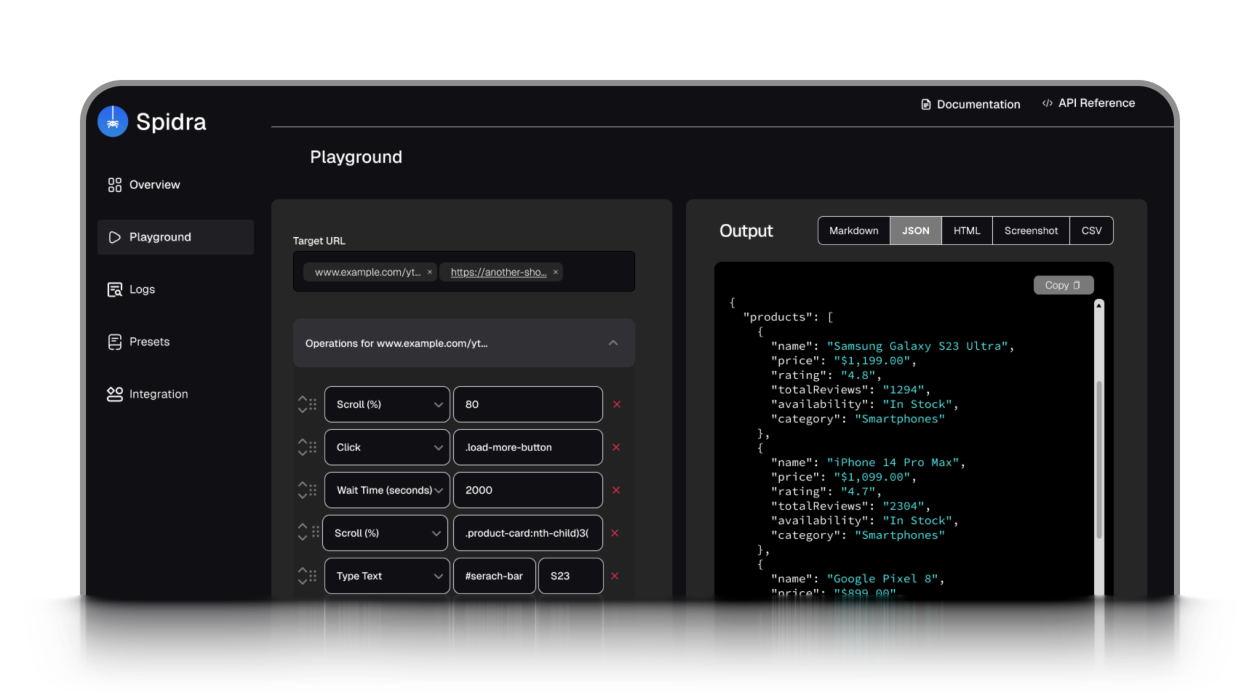
Spidra
Spidra feels like the bridge between human intuition and automation, a scraper that thinks before it scrapes.
ZenRows — The Developer’s Sweet Spot
ZenRows balances flexibility and affordability. It handles JS rendering, proxy rotation, and retries, all behind a single API endpoint.
It’s ideal for developers who want predictable performance without the overhead of enterprise solutions.
Speed: 8.5/10
Formats: HTML, JSON
JS Handling: Yes
Cost per 1,000 requests: Mid-range
Best for: Mid-scale scraping operations
ZenRows is the steady workhorse, not flashy, but dependable.
Olostep — The Markdown-First and AI-Ready Scraper
Imagine if you could turn any website into clean, AI-digestible text in seconds; that’s Olostep’s superpower.
Olostep is a newcomer that feels like it was built for 2025. Instead of just spitting out HTML, it provides structured Markdown, clean JSON, and even rendered HTML formats that plug directly into AI pipelines and content automation tools.
Where others focus on “scraping,” Olostep focuses on data readiness. Its APIs are designed to feed LLMs, not just databases. Developers can send a single URL or upload a batch of thousands, and within minutes, receive fully parsed, JS-rendered results.
Speed & Success Rate: Near-instant for static pages, and surprisingly quick for JavaScript-heavy sites.
JS Handling: Full browser rendering with bot-evasion techniques.
Formats: HTML, Markdown, JSON, PDF.
Cost per 1,000 requests: Low with generous batch pricing and free tier credits.
Developer Experience: Lightweight REST API, clean docs, no SDK bloat.
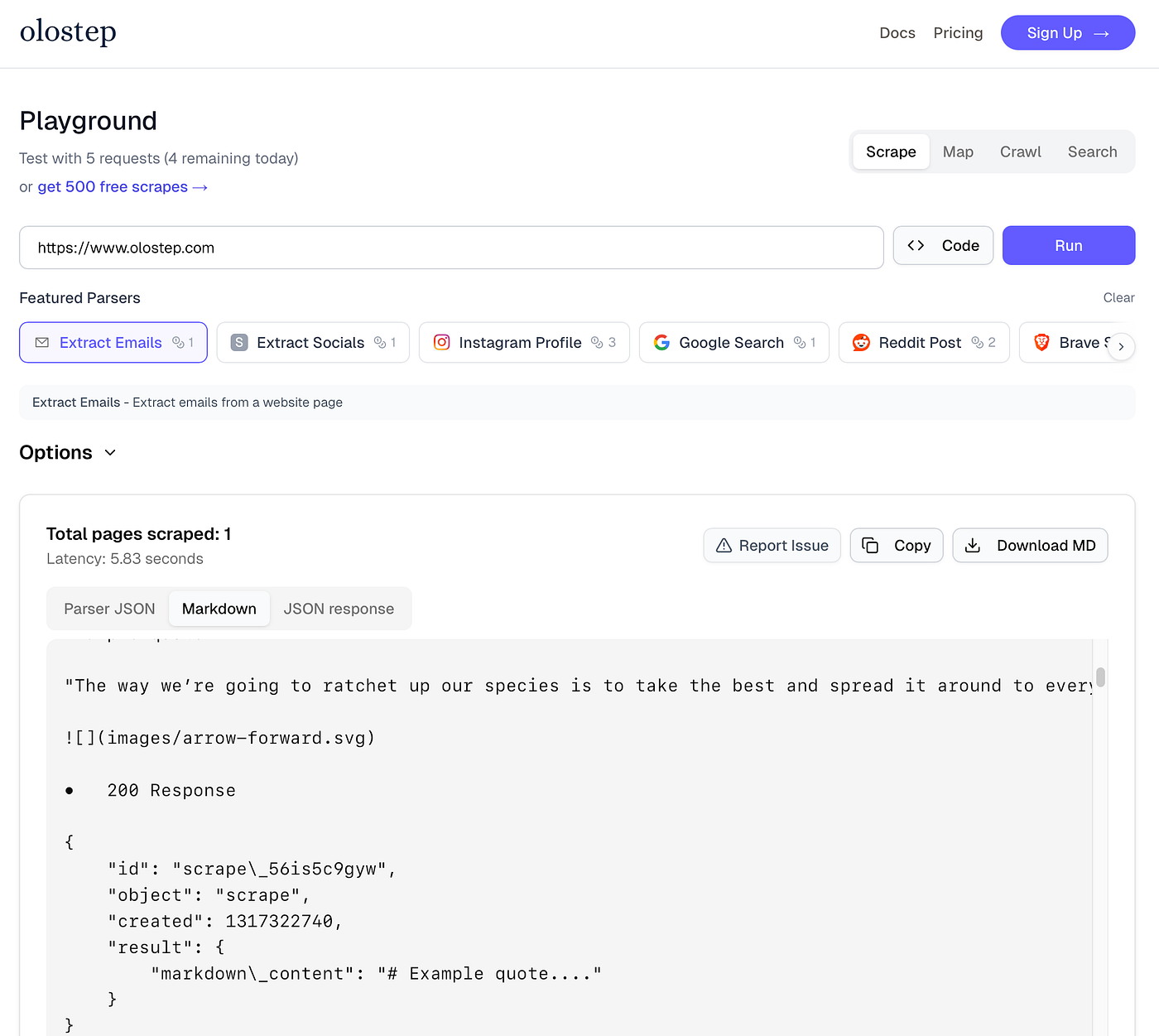
OloStep playground
Olostep feels less like a scraping tool and more like a data pipeline engine,ready for anyone building AI agents, automation bots, or analytical dashboards.
ScraperAPI — Simplicity That Scales
ScraperAPI’s appeal is its plug-and-play simplicity. You make an API call, it returns a fully rendered page, no proxy management, no rotating IP headaches.
Perfect for teams that want something that “just works.”
Speed: 9/10
Formats: HTML, JSON
JS Handling: Yes
Cost per 1,000 requests: Low to moderate
Best for: Quick data pulls and prototypes
ScraperAPI is the fast food of scraping, simple, reliable, and always open.
Bright Data — The Enterprise Giant
Bright Data operates on a different scale, think billions of requests per day across global proxy networks.
It’s built for enterprises that can’t afford downtime and need access to the full spectrum of the web.
It offers managed scraping, proxy rotation, data labeling, and even AI model integration. But it comes at a premium price and complexity level.
Speed: 10/10
Formats: JSON, CSV
JS Handling: Industry-leading
Cost per 1,000 requests: High (enterprise-grade)
Best for: Large organizations & high-volume data feeds
Bright Data is the aircraft carrier of the scraping world — powerful but not agile.
Press enter or click to view image in full size
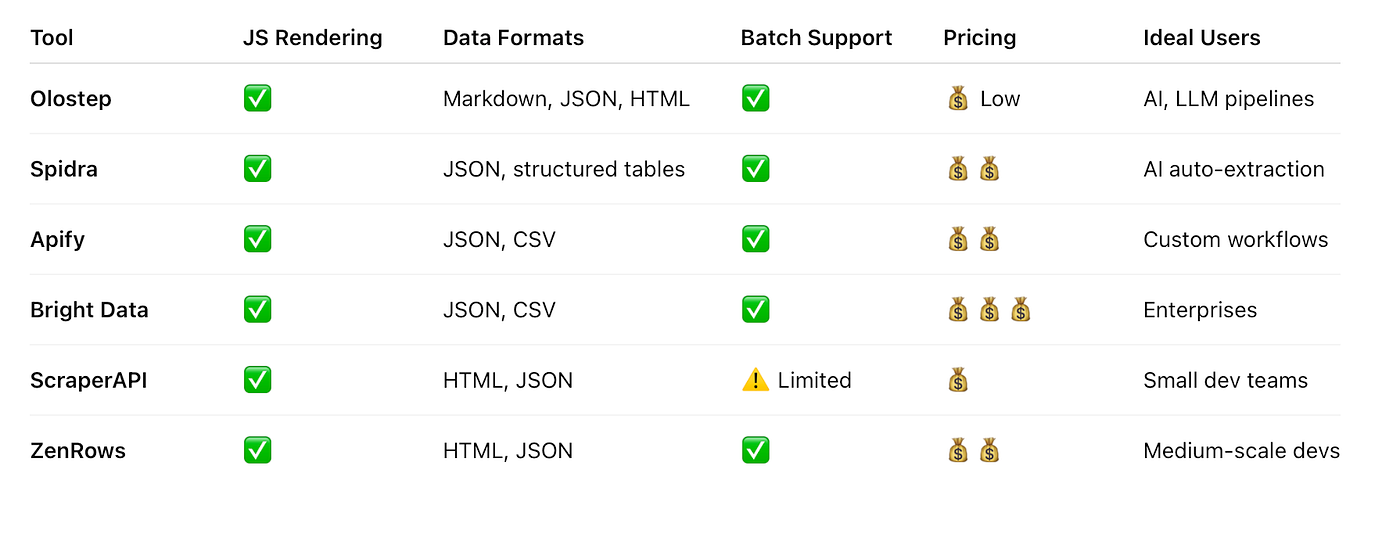
Comparison Table
The Future Belongs to Intelligence, Not Just Access
All these tools scrape the web, but only a few understand it; that’s the new line dividing old-school crawlers from AI-ready data platforms.
Olostep represents that new wave of scrapers built not just to fetch pages, but to interpret them, structure them, and feed them into intelligent systems.
So if 2023 was about scraping the web, 2025 is about teaching your scraper to think.
